NGO Another Way (Stichting Bakens
Verzet), 1018 AM
Edition 05: 13 August, 2010.
Edition 18 : 11 November,
2014.
E-course : Diploma in Integrated
Development (Dip. Int. Dev)
SECTION A : DEVELOPMENT PROBLEMS.
Study value :
04 points out of 18.
Indicative
study time: 112 hours out of 504.
Study points
are awarded only after the consolidated exam for Section A :
Development Problems has been passed.
Second block : The problems to be
solved.
Study points : 02 points out
of 18
Expected work required: 55 hours out of 504
The two study points will be
finally awarded on successful completion of the consolidated exam for Section A : Development problems.
Section 1. Analysis
of the Millennium Goals. [22 hours]
[18.00 Hours] Analysis of the
Millennium Goals.
[04.00 Hours] Preparation report Section 1 of Block
2.
[18.00 Hours] Analysis of the services made available
by integrated development projects.
[05.00 Hours]
Preparation report Section 2 of Block 2.
Second
block : Exam. [ 4 hours each attempt]
Consolidated
exam for Section A : Development problems (for passage
to Section B of the course : [ 6 hours each attempt].
Section 1. Analysis
of the Millennium Goals. [22 hours]
[18.00 Hours] Analysis of the Millennium Goals.
00. Summary of the Millennium
Goals.
01. Eradicate extreme poverty and hunger.
02. Achieve universal primary education.
03. Promote gender equality and empower women.
06. Combat HIV/aids, malaria and other diseases.
07. Target 09 : Ensure
environmental sustainability.
07. Targets 10 and 11 :
Water, sanitation and slums.
08. Develop a global partnership for development.
[18.00 Hours] Analysis of the Millennium Goals.
01. Eradicate extreme poverty and hunger.
(At least 3 hours)
Summary of
goal 1 : Eradicate
extreme poverty and hunger.
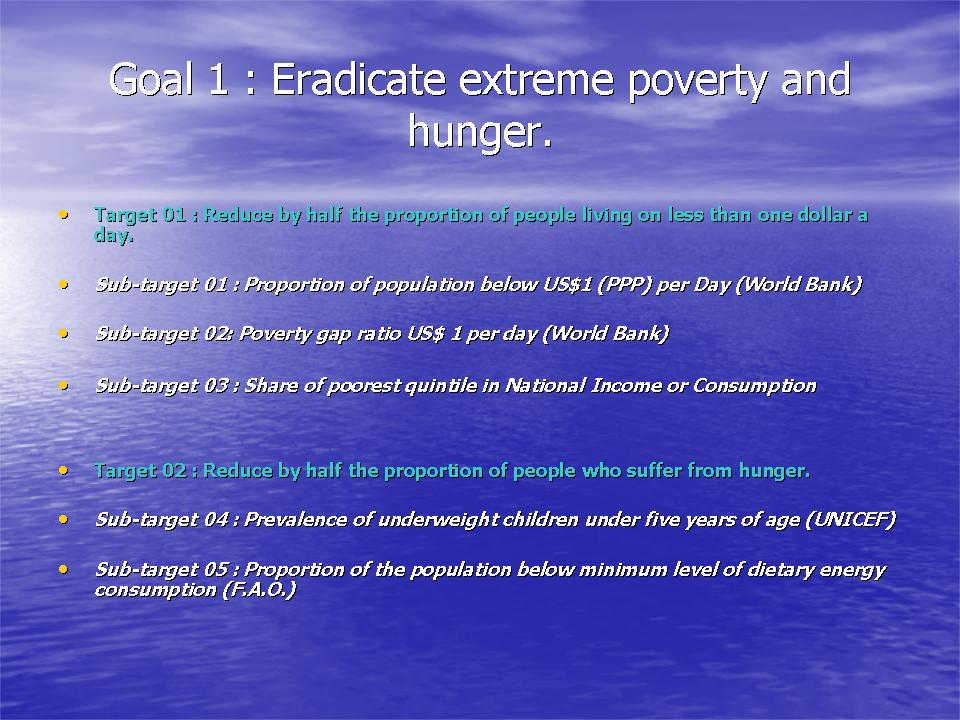
The Millennium Project,
commissioned by the Secretary-General of the United Nations, has produced a
report called A practical plan to achieve the
Millennium Development Goals – 2002-2006. With effect from 1 January 2007 reporting on
the Millennium Development Goals was taken over
by the United Nations Development Programme (UNDP)
which brings out annual reports on progress made in achieving the Development
Goals. The most recent report at the time this course was
written was the Millennium Development Goals
Report 2008. The most recent report published is The Millennium Development
Goals Report 2010. Analysis of these documents is included in parts Goals 1-4 and Goals 5-8 in Section 8 of Block 5.
These reports are intended to sway public opinion. Tucked away at the end
of the reports under the heading “The basis for this analysis” is a sort of
“disclaimer” explaining that where information provided is inadequate of absent
(which is often the case), the editors make an educated guess. For the 2010
report this is at p. 76 and reads :
“Data
are typically drawn from official statistics provided by governments. This is accomplished through periodic data collection by
ministries and national statistical offices around the world. To fill data
gaps, which occur frequently, many of the indicators are supplemented by or
derived exclusively from data collected through surveys sponsored and carried
out by international agencies.”
For an analysis of
the perils of data reporting from Africa, as an example, see Sandefur, F and Glassman, A. : The Political
Economy of Bad Data : Evidence
from African Survey & Administrative Statistics, Center for Global Development
(CGDev), CGD Working Paper 373, Washington, July
2014. From the introduction
(p. 1) :
“…. misrepresentation
of national statistics does not occur merely by accident or due to a lack of
analytical capacity { at least not always ) but rather
that systematic biases in administrative data systems stem from the incentives
of data producers to overstate development progress.”
Information is often based on self-reports by the local agents (nurses and teachers etc) involved resulting in “systematic mis-reporting undermining the state’s ability to manage
public services, particularly in remote rural areas.”(p.3).
“…perverse incentives and lack of functional
independence mean that public and private investment decisions based on poor
data can be deeply flawed, with major implications for well-being and public
expenditure efficiency.” (p. 24)
The production of the statistics themselves often depend on
foreign aid. (p.7)
Paragraphs 7-13 of the Plan of Implementation of the Millennium Goals cover change in
consumption patterns and unsustainable production.
“II. Poverty eradication
7. Eradicating poverty is the
greatest global challenge facing the world today and an indispensable
requirement for sustainable development, particularly for developing countries.
Although each country has the primary responsibility for its own sustainable
development and poverty eradication and the role of national policies and
development strategies cannot be overemphasized, concerted and concrete
measures are required at all levels to enable developing countries to achieve
their sustainable development goals as related to the internationally agreed
poverty-related targets and goals, including those contained in Agenda 21, the
relevant outcomes of other United Nations conferences and the United Nations
Millennium Declaration. This would include actions at all levels to:
(a) Halve, by the year 2015, the
proportion of the world's people whose income is less than 1 dollar a day and
the proportion of people who suffer from hunger and, by the same date, to halve
the proportion of people without access to safe drinking water;
(b) Establish a world solidarity fund
to eradicate poverty and to promote social and human development in the
developing countries pursuant to modalities to be determined by the General
Assembly, while stressing the voluntary nature of the contributions and the
need to avoid duplication of existing United Nations funds, and encouraging the
role of the private sector and individual citizens relative to Governments in funding
the endeavours;
(c) Develop national programmes for
sustainable development and local and community development, where appropriate
within country-owned poverty reduction strategies, to promote the empowerment
of people living in poverty and their organizations. These programmes should
reflect their priorities and enable them to increase access to productive
resources, public services and institutions, in particular land, water,
employment opportunities, credit, education and health;
(d) Promote women's equal access to
and full participation in, on the basis of equality with men, decision-making
at all levels, mainstreaming gender perspectives in all policies and
strategies, eliminating all forms of violence and discrimination against women
and improving the status, health and economic welfare of women and girls
through full and equal access to economic opportunity, land, credit, education
and health-care services;
(e) Develop policies and ways and
means to improve access by indigenous people and their communities to economic
activities and increase their employment through, where appropriate, measures
such as training, technical assistance and credit facilities. Recognize that
traditional and direct dependence on renewable resources and ecosystems, including
sustainable harvesting, continues to be essential to the cultural, economic and
physical well-being of indigenous people and their communities;
(f) Deliver basic health services for
all and reduce environmental health threats, taking into account the special
needs of children and the linkages between poverty, health and environment,
with provision of financial resources, technical assistance and knowledge
transfer to developing countries and countries with economies in transition;
(g) Ensure that children everywhere,
boys and girls alike, will be able to complete a full course of primary
schooling and will have equal access to all levels of education;
(h) Provide access to agricultural
resources for people living in poverty, especially women and indigenous
communities, and promote, as appropriate, land tenure arrangements that
recognize and protect indigenous and common property resource management
systems;
(i) Build
basic rural infrastructure, diversify the economy and improve transportation
and access to markets, market information and credit for the rural poor to
support sustainable agriculture and rural development;
(j) Transfer basic sustainable
agricultural techniques and knowledge, including natural resource management,
to small and medium-scale farmers, fishers and the rural poor, especially in
developing countries, including through multi-stakeholder approaches and
public-private partnerships aimed at increasing agriculture production and food
security;
(k) Increase food availability and
affordability, including through harvest and food technology and management, as
well as equitable and efficient distribution systems, by promoting, for
example, community-based partnerships linking urban and rural people and
enterprises;
(l) Combat desertification and mitigate the effects of
drought and floods through measures such as improved use of climate and weather
information and forecasts, early warning systems, land and natural resource
management, agricultural practices and ecosystem conservation in order to
reverse current trends and minimize degradation of land and water resources,
including through the provision of adequate and predictable financial resources
to implement the United Nations Convention to Combat Desertification in Those
Countries Experiencing Serious Drought and/or Desertification, particularly in
Africa,
(m) Increase access to sanitation to improve human
health and reduce infant and child mortality, prioritizing water and sanitation
in national sustainable development strategies and poverty reduction strategies
where they exist
8. The provision of
clean drinking water and adequate sanitation is necessary to protect human
health and the environment. In this respect, we agree to halve, by the year
2015, the proportion of people who are unable to reach or to afford safe
drinking water (as outlined in the Millennium Declaration) and the proportion
of people who do not have access to basic sanitation, which would include
actions at all levels to:
(a) Develop and implement
efficient household sanitation systems;
(b) Improve
sanitation in public institutions, especially schools;
(c) Promote safe
hygiene practices;
(d) Promote
education and outreach focused on children, as agents of behavioural change;
(e) Promote affordable
and socially and culturally acceptable technologies and practices;
(f) Develop
innovative financing and partnership mechanisms;
(g) Integrate
sanitation into water resources management strategies.
9. Take joint
actions and improve efforts to work together at all levels to improve access to
reliable and affordable energy services for sustainable development sufficient
to facilitate the achievement of the Millennium development goals, including
the goal of halving the proportion of people in poverty by 2015, and as a means
to generate other important services that mitigate poverty, bearing in mind
that access to energy facilitates the eradication of poverty. This would
include actions at all levels to:
(a) Improve
access to reliable, affordable, economically viable, socially acceptable and
environmentally sound energy services and resources, taking into account
national specificities and circumstances, through various means, such as
enhanced rural electrification and decentralized energy systems, increased use
of renewables, cleaner liquid and gaseous fuels and
enhanced energy efficiency, by intensifying regional and international
cooperation in support of national efforts, including through
capacity-building, financial and technological assistance and innovative
financing mechanisms, including at the micro- and meso-
levels, recognizing the specific factors for providing access to the poor;
(b) Improve access
to modern biomass technologies and fuel wood sources and supplies and
commercialize biomass operations, including the use of agricultural residues,
in rural areas and where such practices are sustainable;
(c) Promote a
sustainable use of biomass and, as appropriate, other renewable energies
through improvement of current patterns of use, such as management of
resources, more efficient use of fuel wood and new or improved products and
technologies;
(d) Support the
transition to the cleaner use of liquid and gaseous fossil fuels, where
considered more environmentally sound, socially acceptable and cost-effective;
(e) Develop
national energy policies and regulatory frameworks that will help to create the
necessary economic, social and institutional conditions in the energy sector to
improve access to reliable, affordable, economically viable, socially
acceptable and environmentally sound energy services for sustainable
development and poverty eradication in rural, peri-urban
and urban areas;
(f) Enhance
international and regional cooperation to improve access to reliable,
affordable, economically viable, socially acceptable and environmentally sound
energy services, as an integral part of poverty reduction programmes, by
facilitating the creation of enabling environments and addressing
capacity-building needs, with special attention to rural and isolated areas, as
appropriate;
(g) Assist
and facilitate on an accelerated basis, with the financial and technical
assistance of developed countries, including through public-private
partnerships, the access of the poor to reliable, affordable, economically viable,
socially acceptable and environmentally sound energy services, taking into
account the instrumental role of developing national policies on energy for
sustainable development, bearing in mind that in developing countries sharp
increases in energy services are required to improve the standards of living of
their populations and that energy services have positive impacts on poverty
eradication and improve standards of living.
10.
Strengthen the contribution of industrial development to poverty eradication
and sustainable natural resource management. This would include actions at all
levels to:
(a)
Provide assistance and mobilize resources to enhance industrial productivity
and competitiveness as well as industrial development in developing countries,
including the transfer of environmentally sound technologies on preferential
terms, as mutually agreed;
(b)
Provide assistance to increase income-generating employment opportunities,
taking into account the Declaration on Fundamental
Principles and Rights at Work of the International Labour
Organization;
(c)
Promote the development of micro, small and medium-sized enterprises, including
by means of training, education and skill enhancement, with a special focus on
agro-industry as a provider of livelihoods for rural communities;
(d) Provide financial and technological
support, as appropriate, to rural communities of developing countries to enable
them to benefit from safe and sustainable livelihood opportunities in
small-scale mining ventures;
(e) Provide support to developing countries for the development of safe
low-cost technologies that provide or conserve fuel for cooking and water
heating;
(f) Provide support for natural resource
management for creating sustainable livelihoods for the poor.
11. By 2020, achieve a significant improvement
in the lives of at least 100 million slum dwellers, as proposed in the “Cities without slums"
initiative. This would include actions at all levels to:
(a) Improve access to land and property, to
adequate shelter and to basic services for the urban and rural poor, with
special attention to female heads of household;
(b) Use low-cost and sustainable materials and
appropriate technologies for the construction of adequate and secure housing
for the poor, with financial and technological assistance to developing countries,
taking into account their culture, climate, specific social conditions and
vulnerability to natural disasters;
(c) Increase decent employment, credit and
income for the urban poor, through appropriate national policies, promoting
equal opportunities for women and men;
(d) Remove unnecessary regulatory and other
obstacles for microenterprises and the informal sector;
(e) Support local authorities in elaborating
slum upgrading programmes within the framework of urban development plans and
facilitate access, particularly for the poor, to information on housing
legislation.
12. Take immediate and effective measures to
eliminate the worst forms of child labour as defined in International Labour
Organization Convention No. 182, and elaborate and implement
strategies for the elimination of child labour that is contrary to accepted
international standards.
13. Promote international cooperation to assist
developing countries, upon request, in addressing child labour and its root
causes, inter alia, through social and economic policies aimed at poverty
conditions, while stressing that labour standards should not be used for
protectionist trade purposes.’’
Read the report Making the MDGs Work for All, Corner L. ,
United Nations Development Fund for Women (UNIFEM) ,
Pages 15-44 of the report refer to Millennium
Goal 1.
“Poverty and hunger
not only have a greater impact on women, they are also among the
principal—though not the only—causes of inequality, including gender inequality, and lack of empowerment,
including lack of empowerment for women and girls.”(p.15)
“If poverty and
hunger are to be eradicated, a range of gender and rights issues need to be
addressed, both in relation to poverty and hunger in general, and in relation
to Goal
1. Research.
Make a three-page summary of the 11 factors cited by Mrs Corner for this
purpose. (pp 16-27 of the report).
Take another
look at pages 16-19 of the report.
2. Opinion.
What are the features of a pro-poor policy ? Make two columns on one
page. In the first column write the necessary pro-poor actions. In the second
column write the equivalent traditional development strategies.
Read pages
19-21.
«Most of women’s
contribution to the economy, especially in developing countries, takes place
through the unpaid care economy. » (Page 19)
Poverty is
multi-dimensional.
“From
a rights perspective, poverty consists of failure to achieve and/or utilize a
range of basic capabilities. In addition to adequate nutrition, these include
the capability to avoid preventable and premature mortality; have adequate
shelter; have a basic education; have personal security and equitable access to
justice; and be able to appear in public without shame, earn a livelihood and
take part in community life.” (Page 21)
3.
Opinion.
On one page
describe why this list is different from the one in Section Some factors related to poverty in Section 1 of Block 1 of the course.
Paragraph
“Halve,
by the year 2015, the proportion of the world’s population whose income is less
the US $1 a day and the proportion of people who suffer from hunger and. By the
same date, to halve the proportion of people without safe access to safe
drinking water. ” The benchmark income was subsequently increased to US$ 1.25
per day.
As
even the OECD recently admitted : “Many people who have escaped
poverty as defined by Millennium Development Goal 1a are still poor according
to different thresholds of income poverty, or when measuring poverty according
to its many other dimensions. The MDGs’ focus on
global progress also masks uneven progress across and within countries,
localities and population groups…….Leaving
“There is no clear evidence suggesting a causal relationship between the
setting of MDG-1 and the (uneven) country poverty
reduction results …. The MDG more broadly, need to be
embedded within
a broader narrative on the causes of poverty.” (
“Measuring extreme poverty by the $1.25 per-day threshold is simplistic and
misleading. The indicator has rendered extreme poverty in developed countries
invisible. It has not been eradicated and has worsened after the 2009 economic
and financial crisis. ….One of the weaknesses of the MDG
framework has been its blindness to the issue of inequality and to the most
marginalized members of societies. Its focus on aggregate figures and overall
progress failed to account for growing social and economic disparities and
incentivized States to prioritize aggregate progress and the ‘low-hanging
fruit’ rather than giving special attention to the most vulnerable groups.” (Coyne, B. et al
(ed.), Towards Sustainable Development that Leaves No-one Behind : The Challenge
of the Post-2015 Agenda, Working Paper, International ATD
Fourth World Movement, New York, Pierrelaye and
Geneva, June 2013, p. 10.)
“GDP per capita growth
[in
Some students may be interested in reading D. Woodward’s report How poor
is “poor” ? (New Economics Foundation,
For an opinion on the achievement of the poverty reduction goal see
King, R., What’s up (or down) with
global hunger, ? Guest post, From Power to
Poverty, Duncan Green’s blog, Oxfam GB, 16 October, 2012.) Even without taking
the effects of food price increases in recent years and the accuracy of the
official figures used into account, both
numbers and the prevalence of undernourished are too high in all regions with
respect to the goals. In sub-Saharan Africa the situation has worsened.
For a critical analysis of
target 2 on the reduction of the proportion of people suffering from hunger see Fukuda-Parr S and Orr.A,
The MDG
Hunger Target and the Contested
Vision of Food Security,
“the MDGs did not succeed in
mobilizing attention to hunger. Food security, including issues of small-scale
farmer productivity, vulnerability and nutritional adequacy, was a neglected
issue during much of the 2000s, continuing the trends of the preceding decades
that experienced a precipitous decline in support to agricultural production
and neglect of nutrition. Significant new initiatives were launched by national
governments and multilateral actors during this period including
“Between
2004 and 2013 food prices [in
All food items together :
157%
All vegetables together :
350%
All fruits together : 95%
Rice : 137%
Wheat : 117%
Potato : 185%
Onion : 521%
Tomato : 139%
Cabbage : 714%
Milk : 119%
Eggs : 124%
Sugar : 106%
Salt : 85%.
In any case,
“It is clear that the persistence of higher and more volatile food prices has increased
the number of households that are not eating enough nor able to meet other
basic needs such as education, shelter and healthcare. But the FAO's State of
In
paragraph 20 of his report A/68/183 dated 24 July 2013 to the General Assembly
of the United Nations the Secretary-General stated :
“20. Income inequality has increased in the majority of countries over
the past 30 years. About two thirds of the countries for which data were
available experienced an increase in income inequality between 1990 and 2005,
despite globally robust economic growth. Similarly, the income gap between the
wealthiest and the poorest 10 per cent of income earners increased in 70 per
cent of the countries. There were large differences in mean income across
countries, which accounted for two thirds of global income inequality. Global
wealth was highly concentrated, as the richest 1 per cent of the world’s
population owned 40 per cent of global assets, while the bottom half held just
1 per cent.” (United Nations,
As
the Secretary-General had just pointed out in the preceding paragraph 19 : “growing
inequality jeopardizes progress towards poverty eradication and social
stability. Situations where the poor are excluded from economic growth, or
trapped in low-productivity jobs, result in the gains from growth going
disproportionately to those already better off. ”
Paragraph 20 of the Secretary General’s report refers to the period to
2005. The above-referenced works indicate the situation of the world’s poor has
worsened since then.
It
is doubtful whether claimed progress to halving the share of the world’s population
living off an income of less the US$
1,25 per day has much to do with the MDG’s anyway. As
even the conservative weekly The Economist puts it : “It is not clear how much
the pledge itself caused the fall in poverty—arguably not much, since
“Poor
numbers give room to both politicians and donors that want to negotiate numbers
upwards or downwards…..there are serious gaps in the data that should make us
far more cautious in asserting that the current episode of growth is
‘inclusive’. As indicated, some of this very high growth [in Africa] is driven
by upward revisions, at the same time, a lack of data on poverty in many of the
big countries (Nigeria, Sudan, Angola, DRC), as well as missing data from the
poorer countries on the continent means that better data would probably paint a
more sobering picture than the current very optimistic narratives.” (M. Jerven, Poor Numbers: How We Are Misled by African Development Statistics, Independent Science News,
As
Olivier de Schutter, the Special Reporteur
to the General Assembly of the United Nations on the Right to Food, puts it at
par. 24 of his final report (The Transformative Potential of the Right to Food, United Nations Human Rights Council, 25th Session, Agenda
item 3, A/HRC/25/57,
New York, 24 January, 2014) puts it :
“the promotion in the past of export-led
agriculture, often based on the exploitation of a largely disempowered
workforce, operated at the expense of family farms producing food crops for
local consumption [. This] resulted in a paradoxical situation in which many
low-income countries, though they are typically agriculture-based, raw
commodity-exporting economies, are highly dependent on food imports, sometimes
supplemented by food aid, because they have neglected to invest in local
production and, food processing to feed their own communities (A/HRC/9/23, annex I, para.5). It
also led to increased
rural poverty and the growth of urban slums.”
4.
Opinion.
Make a
two-page analysis. On the first page, on one side give reasons justifying the
choice of 50% ; on the other explain why that choice could be considered
absurd. On the second page, bearing your studies on monetisation in mind, on one side give reasons justifying the
choice of US $1 a day; on the other
explain why that choice could be considered absurd.
Paragraph
“(f)
Deliver basic health services for all and reduce environmental health threats,
taking into account the special needs of children and the linkages between
poverty, health and environment, with provision of financial resources,
technical assistance and knowledge transfer to developing countries and
countries with economies in transition;”
5.
Opinion.
Make a two-page analysis explaining who
should supply the services, the financial resources, the technical assistance
and the technology transfer referred to. On the first page you are an operator
in an industrialised country. On the second page you are the inhabitant of a
rural area in a developing country.
Paragraph 9 e) of Plan of Implementation of the Millennium Goals relates to energy.
It provides:
“(e) Develop national energy
policies and regulatory frameworks that will help to create the necessary economic,
social and institutional conditions in the energy sector to improve access to
reliable, affordable, economically viable, socially acceptable and
environmentally sound energy services for sustainable development and poverty
eradication in rural, peri-urban and urban areas;”
See also the references in section
6. Opinion.
Make a two-page analysis explaining who
should supply the energy services. On the first page you are an operator in an
industrialised country. On the second page you are the inhabitant of a rural
area in a developing country.
◄ Second block : Problems to be solved.
◄ Index : Diploma in Integrated Development (Dip. Int. Dev)
This work is
licensed under a Creative Commons Attribution-Non-commercial-Share Alike
3.0 Licence.
